Linear vs Exponential Growth: Why 1% Daily Equals 37x Yearly
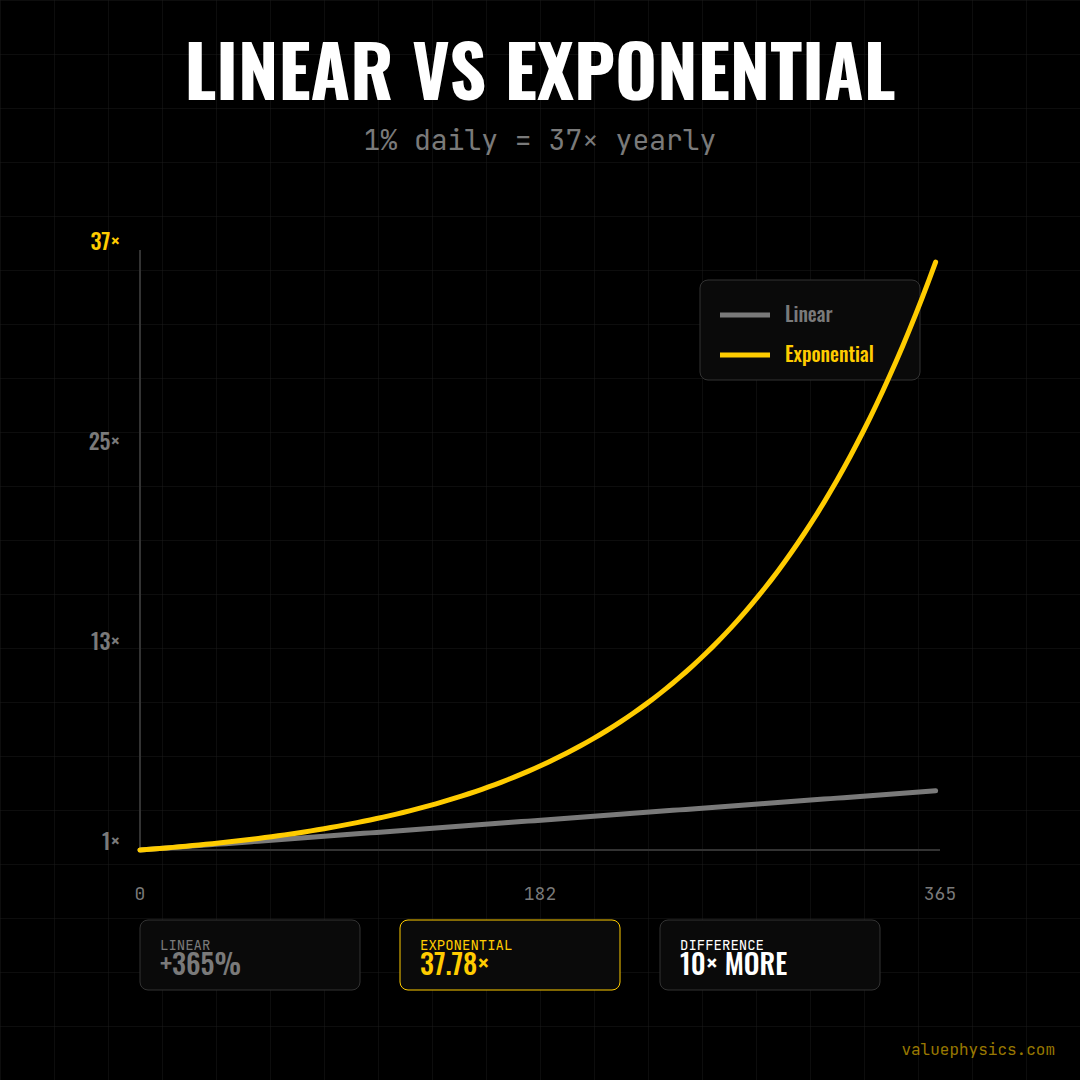
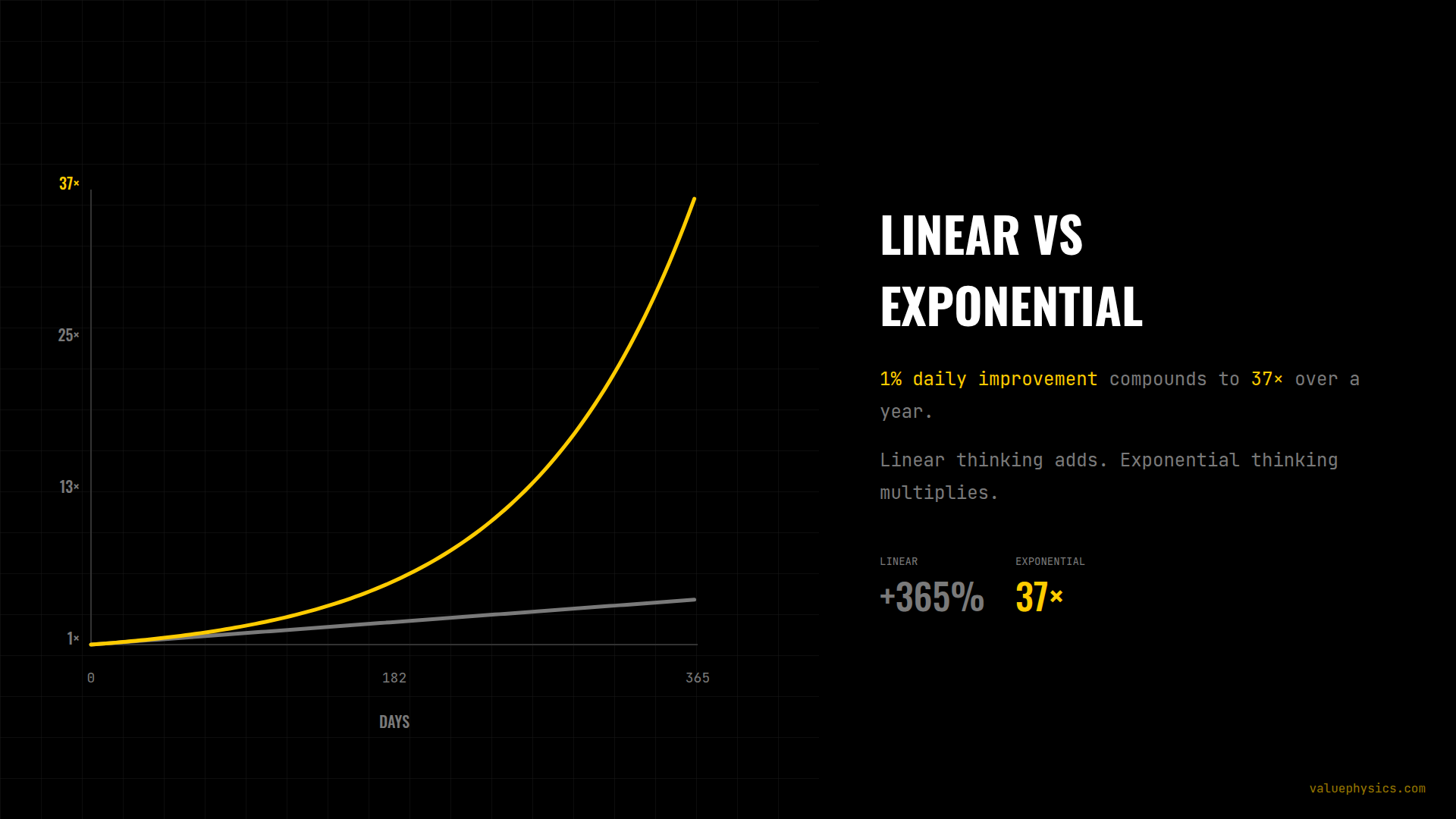
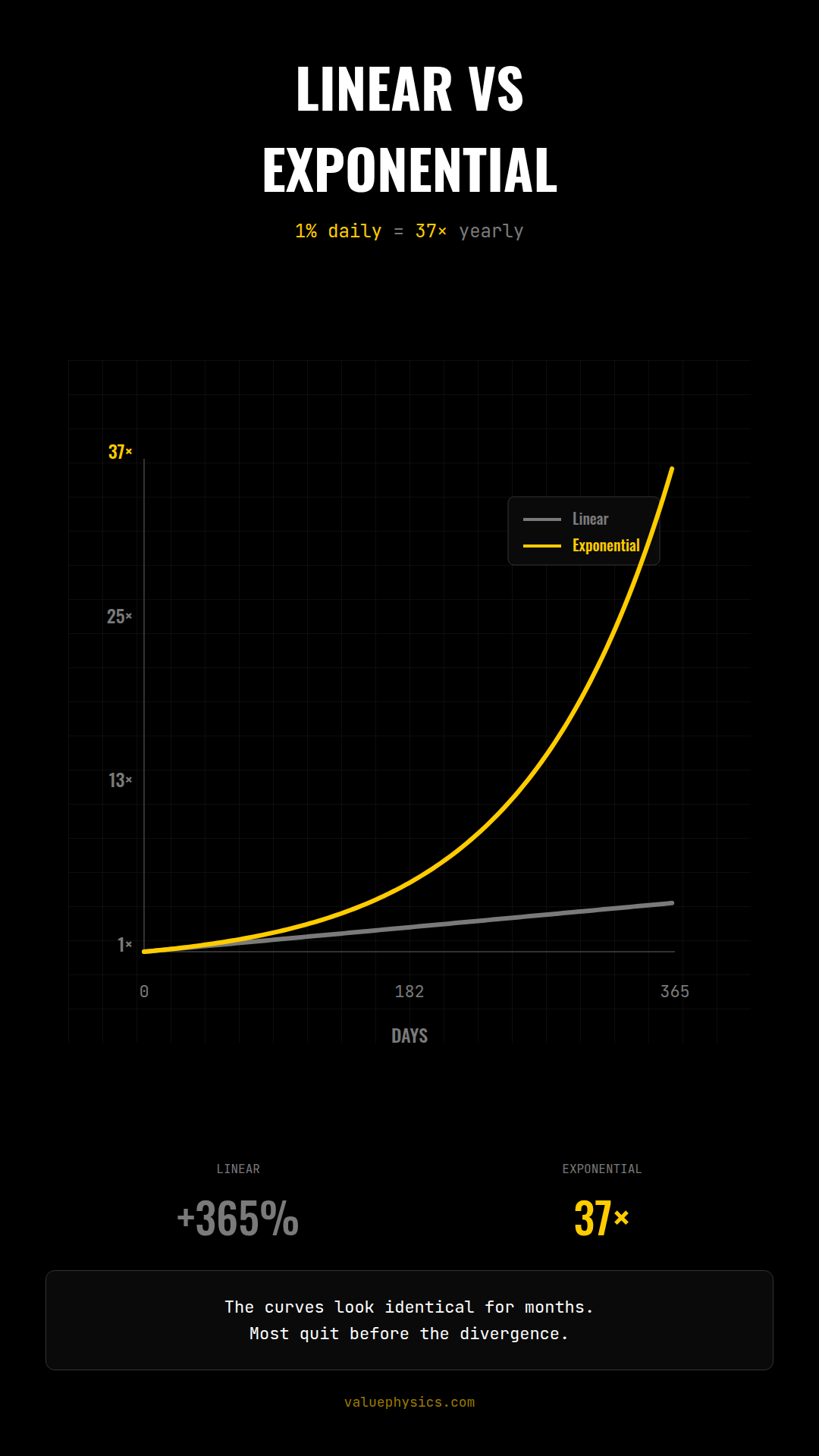
Linear growth adds a constant amount. Exponential growth multiplies by a constant rate. This fundamental difference creates dramatically different outcomes over time. A 1% daily improvement—barely noticeable day to day—compounds to 37x your starting point after one year. Linear improvement at the same pace yields only +365%.
Understanding this distinction is crucial for anyone serious about personal development, investing, business growth, or skill acquisition. The math behind exponential growth explains why some people seem to achieve extraordinary results while others plateau—and it's rarely about talent or starting advantages. It's about understanding how growth actually works.
| Linear Growth | Exponential Growth | |
|---|---|---|
| Pattern | Add (+) | Multiply (×) |
| Formula | start + (rate × time) | start × (1 + rate)^time |
| 1% daily for 1 year | +365% | 37× (3,700%) |
| Shape | Straight line | Hockey stick curve |
Key Takeaways
- → Linear = adding. Exponential = multiplying. The difference compounds over time.
- → 1% daily improvement = 37× yearly (not 365%).
- → For the first 100 days, both curves look nearly identical—most people quit here.
- → Compound interest, skill acquisition, and network effects all follow exponential patterns.
- → Patience through the "flat zone" is the price of exponential results.
- → The Rule of 72: Divide 72 by your growth rate to estimate doubling time.
Linear vs Exponential: Day-by-Day Comparison
This table reveals why exponential growth is so deceptive—and so powerful. At 1% daily improvement, watch how the gap between linear and exponential widens dramatically over time:
| Day | Linear (1% added) | Exponential (1% compounded) | Gap |
|---|---|---|---|
| Day 1 | 1.01× | 1.01× | 0% |
| Day 30 | 1.30× | 1.35× | +4% |
| Day 100 | 2.00× | 2.70× | +35% |
| Day 200 | 3.00× | 7.32× | +144% |
| Day 365 | 4.65× | 37.78× | +712% |
Notice: At day 100, the gap is only 35%. By day 365, it's 712%. This is why most people quit too early—they evaluate their progress during the "flat zone" where both curves look nearly identical.
Interactive Visualization: Linear vs Exponential
THE CORE LESSON
The Math Behind Exponential Growth
Real-World Examples of Exponential Growth
Moore's Law
Computing power doubles approximately every 18-24 months. A smartphone today has more processing power than all of NASA had during the Apollo missions. This exponential curve is why AI capabilities seem to explode "suddenly"—they were compounding invisibly for decades.
Social Media Followers
Each new follower increases your reach, making it easier to gain the next follower. Early creators grow painfully slowly—100 followers might take months. But at 10,000, you might gain 100/day. At 100,000, 1,000/day. The algorithm rewards momentum exponentially.
Skill Acquisition
Skills compound because fundamentals enable advanced techniques. Learning to code: basic syntax → functions → data structures → frameworks → architecture. Each layer multiplies your capability. A 5-year programmer isn't 5× better than a 1-year programmer—they're often 50× more productive.
Fitness Gains
Progressive overload follows exponential patterns early on. Adding 5 lbs to your squat weekly means your strength compounds: 100 → 105 → 110.25 (with proper recovery). But here's the trap: most people think linearly, expect instant results, and quit in month 2 when they should push to month 6.
Why Exponential Thinking Matters
The Deception Zone (Days 1-100)
For the first 100 days, linear and exponential curves look almost identical. This is where most people quit—they don't see dramatic results, so they assume the strategy isn't working. But exponential growth is designed to be invisible early. The work you do in the deception zone is building the foundation for everything that comes after.
The Inflection Point (Days 200-250)
Around day 200-250, the curves diverge dramatically. By day 365, a 1% daily improvement compounds to 37× your starting point. Linear thinking at the same rate yields only +365%. The patient inherit the exponential gains. This is where people who persisted through the flat zone finally see their results take off.
Classic Examples
- Compound interest: $10,000 at 7% = $76,122 in 30 years (no additional contributions)
- Skill acquisition: 1% better daily = elite in 3-5 years
- Network effects: Each user adds value for all users (exponentially)
- Content creation: Views compound as your library grows and the algorithm trusts you
- Business revenue: Retained customers refer new customers, compounding growth
Common Mistakes: Why People Quit Too Early
Mistake #1: Measuring Progress Linearly
"I've been at this for 3 months and I'm only 3× better." That's exactly where you should be. Exponential growth feels disappointing early because we instinctively compare to linear expectations. At month 3, the exponential curve is still in its flat phase. You're building the foundation for month 9's explosion, but it doesn't feel that way.
Mistake #2: Comparing to Others' Visible Results
You see someone's impressive results (YouTube channel, business revenue, fitness transformation) and assume they got there quickly. You're seeing their day 365—the explosive visible part of the curve. You're not seeing their day 1-200 when their results looked exactly like yours do now. Survivorship bias hides the flat zone.
Mistake #3: Breaking the Chain
Miss one day and you don't just lose that day—you lose the compound interest on that day. At 1% daily, missing day 100 means you're not at 2.70× on day 101; you're at 2.67×. It seems small, but those gaps multiply. Consistency isn't about perfection; it's about understanding that each day builds on every previous day.
Mistake #4: Switching Strategies Before Compound Kicks In
"This approach isn't working, let me try something new." Every time you restart, you return to day 1 of a new curve. Strategy-hoppers never reach the inflection point because they abandon each approach during its flat zone. The best strategy is often the one you stick with long enough to see exponential gains.
Mistake #5: Underestimating Small Differences
1% vs 0.5% daily seems negligible. But 1.01^365 = 37.78× while 1.005^365 = 6.17×. That "small" difference of 0.5% creates a 6× gap in outcomes over a year. This is why marginal gains matter enormously in exponential systems—and why cutting corners has outsized consequences.
How to Think Exponentially: A Practical Guide
Exponential thinking isn't just about understanding the math—it's about rewiring how you evaluate progress, make decisions, and persist through the flat zone. Here's how to train your brain to think in curves instead of lines:
- Redefine "working" — Linear thinkers ask "Am I seeing results?" Exponential thinkers ask "Am I compounding?" If you're improving by any amount and not quitting, it's working. Results come later.
- Use the Rule of 72 — Calculate doubling times to make exponential growth tangible. At 7% annual returns, your investment doubles every ~10 years. At 1% daily improvement, you're 2× better in 72 days, 4× in 144 days, 8× in 216 days.
- Measure in multipliers, not additions — Instead of "I gained 10 followers," think "I grew 2%." Instead of "I added $500 to savings," think "I grew my net worth by 1.5%." Percentages reveal the compound potential.
- Zoom out your time horizon — Stop evaluating progress weekly. Evaluate quarterly or yearly. A 1% daily improvement is invisible on a daily chart, obvious on an annual chart. Match your measurement timeline to the growth pattern.
- Build systems, not goals — Goals are linear ("reach X by Y date"). Systems are exponential ("improve 1% forever"). The person with the system will surpass the goal-setter because they never stop compounding.
- Trust the math over your feelings — Your intuition will scream that it's not working during the flat zone. The math says otherwise. When in doubt, plot your progress on a curve and remind yourself where you are in the trajectory.
- Invest in compounding assets — Time, skills, relationships, and capital all compound differently. Prioritize investments where today's gain becomes tomorrow's input: learning, network-building, automated systems.
- Embrace the boring middle — The exciting parts of exponential growth are the beginning (novelty) and the end (explosive results). The middle 70% is boring, repetitive, and crucial. Learn to love the boring middle.
How to Apply Exponential Thinking to Your Life
- Choose your 1% — What skill, metric, or habit can you improve by 1% daily? Pick one. Spreading effort across many things dilutes the compound effect.
- Track obsessively — Measure the small gains. They compound invisibly but they compound. What gets measured gets managed—and compounded.
- Survive the flat zone — Days 1-100 feel pointless. They're building the foundation for the explosion. Your only job is to not quit.
- Don't break the chain — Consistency beats intensity. Missing one day costs more than you think because of lost compounding.
- Reinvest gains — Use today's output as tomorrow's input. That's how compounding works. Don't cash out your compound interest prematurely.
Watch: Exponential Growth Explained
Frequently Asked Questions
What is the difference between linear and exponential growth?
Linear growth adds a constant amount over time (e.g., +10 every day), resulting in a straight line. Exponential growth multiplies by a constant rate (e.g., ×1.01 every day), creating a curve that starts slowly then accelerates dramatically. The key difference: linear growth is additive, exponential growth is multiplicative.
Why does 1% daily equal 37x yearly?
The math is 1.01^365 = 37.78. Each day you multiply by 1.01 (your previous value plus 1%). Over 365 days, these multiplications compound. Early gains are small, but by mid-year you're multiplying much larger numbers by 1.01, creating explosive growth in the final months.
What is the 1% rule?
The 1% rule states that improving by just 1% daily leads to being 37 times better after one year. It's a framework for understanding how small, consistent improvements compound into massive results over time. The rule applies to skills, habits, investments, and any metric that can grow multiplicatively.
What is an example of exponential growth in real life?
Common examples include: compound interest on investments (7% annually doubles your money in ~10 years), viral content spreading (each share creates more shares), skill acquisition (fundamentals enable advanced techniques which enable mastery), and business network effects (each new user makes the platform more valuable for all users).
Why do most people fail to achieve exponential growth?
For the first 100+ days, linear and exponential curves look nearly identical. Most people quit during this 'deception zone' because they don't see dramatic results. Exponential growth requires patience through the flat early period and consistency to reach the inflection point where gains accelerate visibly.
How do I apply exponential thinking to my life?
Choose one metric to improve by 1% daily—a skill, savings rate, or habit. Track progress obsessively. Survive the flat zone (days 1-100) without quitting. Reinvest gains as tomorrow's starting point. The compound effect works in fitness, learning, investing, content creation, and relationships.
What is the Rule of 72?
The Rule of 72 is a quick mental math shortcut for estimating how long it takes for an investment to double at a given interest rate. Simply divide 72 by the annual growth rate. At 7% returns, your money doubles in roughly 72÷7 = 10.3 years. At 12%, it doubles in 6 years. This rule helps visualize exponential growth without a calculator and demonstrates why even small differences in growth rates create massive long-term gaps.
How does exponential growth apply to investing?
Investing is perhaps the purest real-world example of exponential growth through compound interest. When you reinvest dividends and gains, you earn returns on your returns. A $10,000 investment at 7% annual return becomes $76,122 in 30 years—without adding any additional money. The magic happens late: most of that $66,122 gain occurs in the final 10 years. This is why starting early matters more than starting big. Time in the market enables the exponential curve to work its magic.
What is the difference between exponential and geometric growth?
In practical terms, they're the same thing. Both describe growth where each new value is multiplied by a constant factor. 'Geometric growth' typically refers to discrete time intervals (doubling every generation), while 'exponential growth' can apply to continuous time. In finance, 'compound growth' and 'exponential growth' are used interchangeably. The key insight remains identical: multiplicative growth creates hockey-stick curves where most gains happen at the end.
Why do humans struggle to understand exponential growth?
Our brains evolved for a linear world. For most of human history, if you walked twice as far, you got twice as much food. Our intuition defaults to linear extrapolation—we expect tomorrow to look like today plus a small increment. Exponential growth violates this intuition because early stages look deceptively flat. We can't 'feel' the curve until it's too late. This cognitive bias, called exponential growth bias, explains why people underestimate pandemics, debt accumulation, and compound investment returns.